
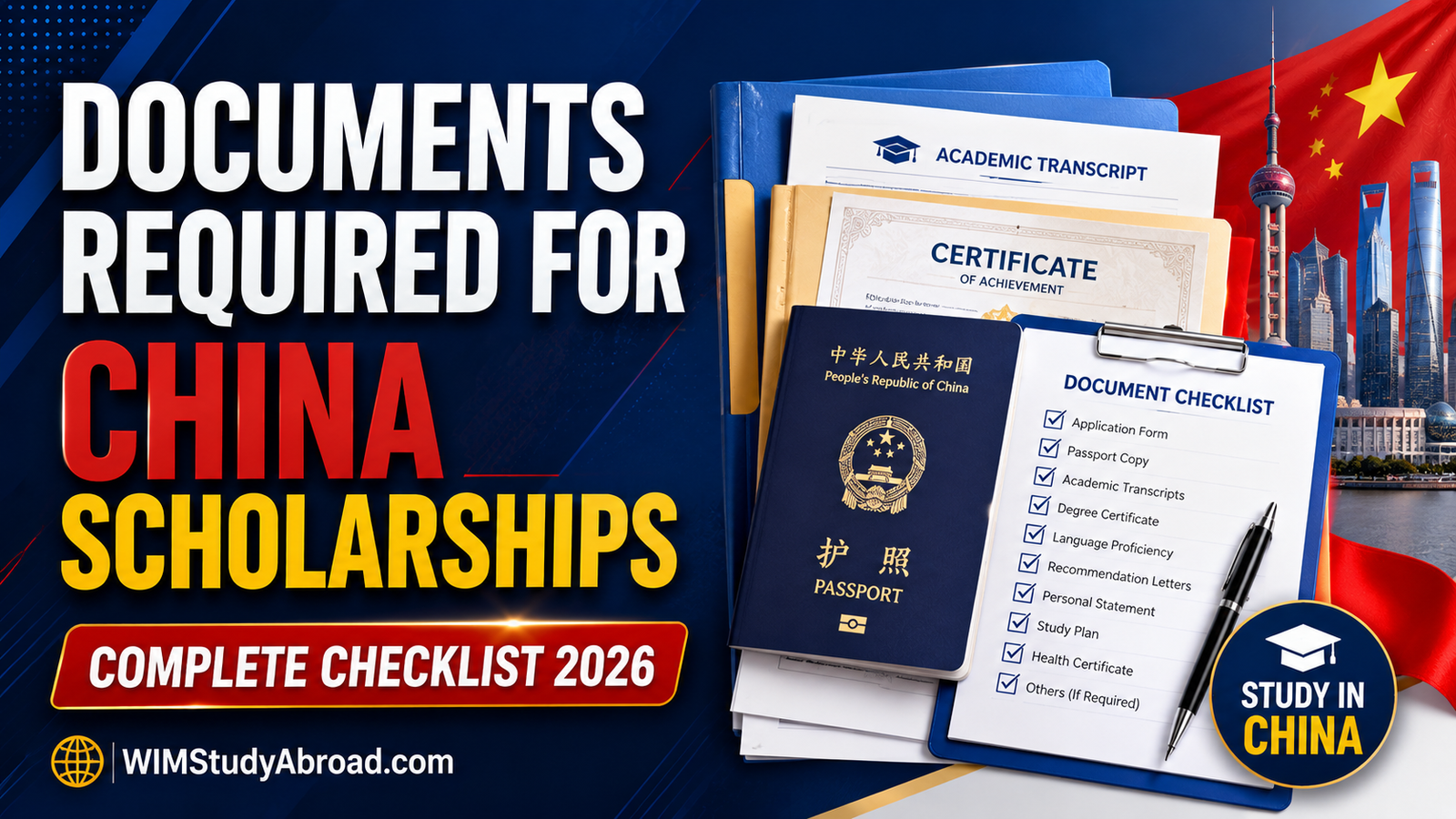
| Document requirements are not identical for every scholarship or university. This guide explains the documents commonly required for current Chinese Government Scholarship applications and other China scholarship applications. Always check the official notice for your scholarship route and target university before submitting. |
Introduction
A strong scholarship application is not only about good grades. Your documents must also be complete, clear and prepared in the correct format.
Many students lose time because they start collecting documents too late, use unclear scans, submit expired certificates or follow an old checklist. The safest approach is to prepare the main documents early and then compare your file with the latest official requirements for your scholarship route.
For the 2026/2027 Chinese Government Scholarship cycle, official notices list documents such as the scholarship application form, passport, highest diploma, academic transcripts, language certificates, pre-admission documents, a study plan or research proposal, and other supporting documents depending on the applicant’s study level and situation.
Quick Document Checklist
| Document | Who Usually Needs It | Key Point |
| Scholarship application form | CGS applicants | Generated after completing the online application. |
| Passport information page | Most applicants | Use a clear scan of a valid ordinary passport. |
| Highest diploma / expected graduation proof | Most applicants | Notarization and translation may be required. |
| Academic transcripts | Most applicants | Use complete and readable records. |
| Language qualification | Depends on program | HSK, IELTS, TOEFL or other accepted proof may be required. |
| CSCA score report | Bachelor’s applicants under current CGS rules | Required under the 2026/2027 CGS cycle. |
| Pre-admission document | Required in many current CGS routes | May be a pre-admission notice or other accepted university document. |
| Study plan / research proposal | Most CGS applicants | Length depends on study level. |
| Recommendation letters | Graduate / senior scholar applicants | Usually two academic recommendation letters. |
| Physical examination form | Applicants staying over 6 months | Must be complete and valid. |
| Non-criminal record | Common CGS requirement | Usually must be recently issued. |
| Guardian documents | Applicants under 18 | Required where applicable. |
| Art / design portfolio | Art or design applicants | Required or useful where the program asks for work samples. |
1. Chinese Government Scholarship Application Form
For Chinese Government Scholarship applications, the application form is completed through the official Chinese Government Scholarship Information System. After you enter the required information correctly, the system creates the application form.
Check your personal details, study level, preferred program, university choices and contact information carefully before final submission. A spelling mistake in your name or passport details can create problems later.
2. Passport Information Page
A clear scanned copy of the information page of your ordinary passport is one of the basic documents.
Current 2026/2027 CGS guidance states that if the passport will have less than 12 months of validity from the expected start of study, the applicant should renew it and use the new passport for the scholarship application.
- Make sure your full name is readable.
- Check that your date of birth and nationality match your other documents.
- Scan the full information page without cutting the edges.
- Do not upload a blurred mobile photo if you can make a clean scan.
3. Highest Diploma or Expected Graduation Proof
Applicants normally need to provide their highest academic diploma. For example, a master’s applicant will usually provide a bachelor’s degree certificate, while an undergraduate applicant will provide the relevant secondary-school qualification.
If you have not graduated yet, current CGS notices allow prospective graduates to submit official proof of student status or expected graduation from their current school.
Documents that are not in Chinese or English may need a notarized Chinese or English translation. Always check the exact translation and notarization rule in the official notice you are following.
4. Academic Transcripts
Academic transcripts show the subjects you studied and the grades or marks you received. They are an important part of the academic review.
Prepare complete transcripts for the qualification relevant to your application. Do not upload only selected pages if your official transcript has several pages.
- Check that your name matches your passport.
- Make sure every page is readable.
- Include the grading scale if your institution provides one.
- If the transcript is not in Chinese or English, check whether a notarized translation is required.
5. Language Qualification Certificate
The required language document depends on the teaching language and the rules of the university.
For Chinese-taught programs, applicants may need an HSK certificate at the level required by the scholarship or university. For programs taught in another language, universities may ask for IELTS, TOEFL or another accepted form of language proof.
| Do not assume one rule applies everywhere. A university may set a higher language requirement than the general scholarship requirement. Always check the admissions page of the university and the scholarship notice together. |
6. CSCA Score Report for Bachelor’s Applicants
The 2026/2027 Chinese Government Scholarship cycle introduced an important requirement for bachelor’s applicants: a valid China Scholastic Competency Assessment (CSCA) score report.
Applicants should check with the target institution which CSCA subjects are required for the chosen major. The exact test arrangement can depend on the intake and university.
7. Pre-Admission Documents
Pre-admission documents are important in many current Chinese Government Scholarship routes. Official 2026/2027 notices may require applicants to contact target universities before submitting the scholarship application and obtain an accepted pre-admission document.
Depending on the route and university, this may include a pre-admission notice from the international admissions office, an invitation letter from a school or department, or another accepted document described in the official notice.
| Check the exact route. Do not assume that an informal email is enough. Confirm what your scholarship authority and target university accept as a pre-admission document. |
8. Study Plan or Research Proposal
A study plan explains what you want to study, why you selected the program, and what you hope to achieve. For research degrees, the document may also explain your research interests, proposed topic, methods or academic goals.
Current 2026/2027 CGS notices use minimum lengths of 200 words for undergraduate applicants, 500 words for non-degree applicants and 800 words for postgraduate applicants in some routes.
| Study Level | Common Minimum in Current CGS Notices |
| Undergraduate | 200 words |
| Non-degree / scholar program | 500 words |
| Postgraduate | 800 words |
Treat these as minimum requirements for the relevant CGS notices, not as a universal rule for every scholarship. Your target university may ask for a different format or more detail.
9. Recommendation Letters
Graduate and senior scholar applicants commonly need two recommendation letters in Chinese or English from professors or associate professors under current CGS guidance.
A useful recommendation letter should come from someone who can comment on your academic ability, research potential, work quality or suitability for further study.
- Ask early. Professors may need time to prepare the letter.
- Use the recommender’s correct academic title and contact details.
- Follow any university rule about signatures, letterhead or sealed copies.
- Do not submit a generic letter that has no connection to your academic background.
10. Foreigner Physical Examination Form
Applicants who plan to stay in China for more than six months are commonly required to submit a copy of the Foreigner Physical Examination Form.
Official guidance states that the examination should cover all items listed on the form. Incomplete forms, or forms missing the attending physician’s signature, hospital stamp or sealed photograph, can be treated as invalid.
The medical examination result is generally valid for six months under current CGS notices, so do not complete it too early.
11. Non-Criminal Record or Police Clearance
A valid non-criminal record certificate, often called a police clearance certificate, is a common current CGS requirement.
Official 2026/2027 notices generally state that the certificate should be issued by the relevant local public-security authority and is usually expected to have been issued within six months before the application is submitted.
- Check the name on the certificate.
- Check the issue date.
- If a translation is required, follow the official translation rule.
- Do not use an old certificate simply because you used it for a previous application.
12. Documents for Applicants Under 18
Applicants under the age of 18 may need to provide valid documents relating to a legal guardian in China. The exact requirement can depend on the scholarship route and university.
If you will be under 18 at the relevant time, contact the university or scholarship authority early instead of waiting until the final application stage.
13. Art or Design Portfolio
Applicants to art or design-related majors may need to provide examples of their work. Current CGS guidance allows art applicants to upload work samples in the supporting-document area or provide them to the target university through another accepted method.
Check the university’s portfolio rules carefully. File format, number of works, size limits and subject requirements can differ by program.
14. Translation and Notarization
Translation and notarization are common areas where applicants make mistakes.
Current CGS notices state that diplomas and transcripts in languages other than Chinese or English should be accompanied by notarized Chinese or English translations in the relevant routes.
| Situation | What to Check |
| Document already in Chinese or English | Check whether a separate notarization requirement still applies. |
| Document in another language | Check whether a notarized Chinese or English translation is required. |
| Name spelling differs across documents | Correct or formally explain the difference before submission. |
| Several-page document | Make sure every required page and translation page is included. |
Do not create your own unofficial translation unless the scholarship authority or university clearly allows it.
15. Scan Quality and File Preparation
Official scholarship notices repeatedly warn that uploaded supporting documents must be clear, authentic and valid.
Before uploading a file, open it on a computer and check it at normal zoom. If you cannot easily read the text, the reviewer may have the same problem.
- Use a scanner or a high-quality scanning app.
- Keep pages straight and fully visible.
- Avoid shadows, fingers and reflections.
- Use sensible file names, such as Passport.pdf or Bachelor-Transcript.pdf.
- Do not upload password-protected files unless the system specifically accepts them.
- Check the file-size and file-format limits of the application portal.
Common Document Mistakes to Avoid
| Mistake | Better Approach |
| Using an expired or nearly expired passport | Check validity early and renew if required. |
| Uploading incomplete transcripts | Prepare the complete academic record. |
| Ignoring translation requirements | Use the translation and notarization method stated in the official notice. |
| Submitting an old police clearance | Check the permitted issue period. |
| Doing the medical exam too early | Remember that the result may be valid for only six months. |
| Using the same language rule for every university | Check the target university’s exact requirement. |
| Forgetting CSCA for a bachelor’s CGS application | Check the latest CSCA requirement and required subjects. |
| Using blurry phone photographs | Scan documents clearly before upload. |
| Waiting until the final day | Prepare documents well before the deadline. |
Final Check Before You Submit
Before pressing the final submit button, compare your application with the official checklist for your scholarship route and target university.
- Your name and personal details match your passport.
- Your passport is valid for the required period.
- Your diploma and transcripts are complete.
- Translations and notarization are prepared where required.
- Your language certificate meets the university requirement.
- Your CSCA report is included if it applies to your bachelor’s application.
- Your pre-admission document is in the accepted form.
- Your study plan or research proposal meets the required length and format.
- Recommendation letters are included if required.
- Your physical examination and police clearance are still valid.
- Every uploaded file is clear, authentic and readable.
Frequently Asked Questions
Do all China scholarships require the same documents?
No. Requirements vary by scholarship, university, study level and application route. The checklist in this guide covers common documents, especially those appearing in current Chinese Government Scholarship guidance.
Do my academic documents need to be notarized?
Current CGS notices require notarized highest diplomas in relevant routes, and documents in languages other than Chinese or English may require notarized translations. Check the exact notice for your route.
Can I apply if I have not graduated yet?
Current CGS guidance allows prospective graduates to provide official proof of student status or expected graduation from their current institution, subject to the applicable route and university requirements.
Is IELTS compulsory for every scholarship?
No. Language requirements depend on the teaching language and university. Some programs use HSK requirements, while English-taught programs may require IELTS, TOEFL or another accepted form of proof.
Do bachelor’s applicants need CSCA in 2026?
For the 2026/2027 Chinese Government Scholarship cycle, official notices require bachelor’s applicants to provide a valid CSCA score report. Applicants should confirm the required subjects with the target university.
How recent should the police clearance be?
Current CGS notices commonly state that the non-criminal record should usually have been issued within six months before the application submission date.
Final Thoughts
Scholarship documents should be prepared carefully, not simply collected as quickly as possible.
Start early, use the latest official checklist, keep your documents clear and consistent, and verify every important requirement with the scholarship authority and your target university before submission.
A complete and well-prepared file cannot guarantee a scholarship, but it can prevent avoidable mistakes that may weaken or delay an application.