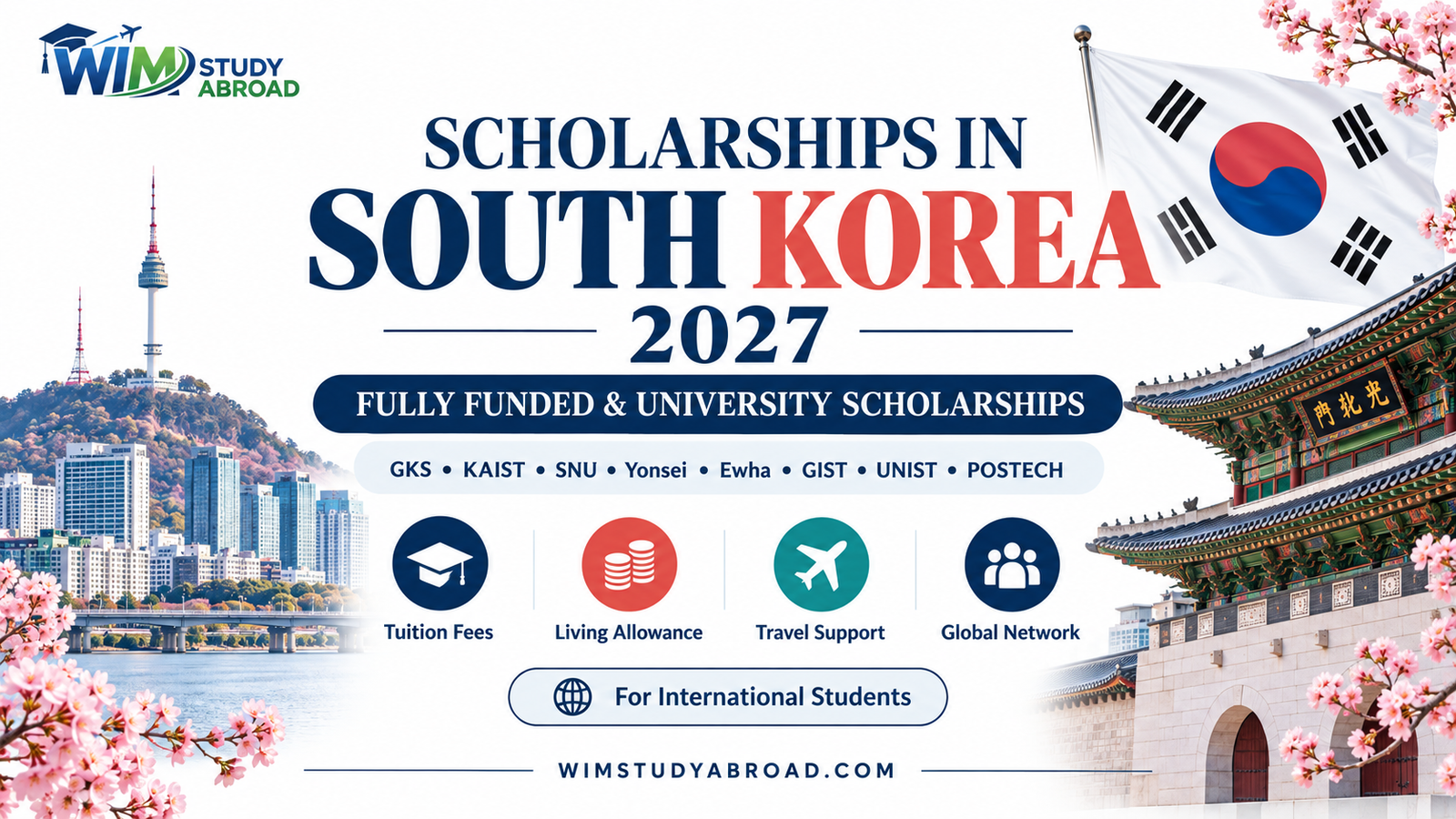
South Korea offers several scholarship opportunities for international students at undergraduate, Master’s and PhD levels. Funding is available through the Korean Government, individual universities and institutional scholarship programs. Some scholarships provide comprehensive support including tuition, monthly allowances and airfare, while others provide full or partial tuition waivers. For students planning to study in South Korea in 2027, important opportunities include the Global Korea Scholarship (GKS), KAIST Scholarship, Seoul National University scholarships, Yonsei University scholarships, Ewha Global Partnership Program, GIST scholarships, UNIST scholarships, POSTECH scholarships and other university-based awards.
This guide explains the major scholarships international students can explore for the 2027 intake.
South Korea Scholarships 2027 at a Glance
| Scholarship | Degree Level | Main Support |
|---|---|---|
| Global Korea Scholarship (GKS) | Undergraduate, Master’s, PhD | Tuition, allowance, airfare, language training and other support |
| KAIST Scholarship | Undergraduate, Master’s, PhD | Full tuition and financial support |
| Seoul National University Scholarships | Undergraduate, Master’s, PhD | Full/partial tuition and selected living support |
| Yonsei Global Leader Fellowship | Master’s, PhD | Full tuition, entrance fee and stipend |
| Ewha Global Partnership Program | Undergraduate, Master’s, PhD | Full tuition, housing and stipend |
| GIST Scholarship | Master’s, PhD | Full tuition, allowances and research support |
| UNIST Scholarships | Undergraduate | Tuition support and additional financial support |
| POSTECH Scholarships | Undergraduate, Master’s, PhD | Full tuition and additional support depending on program |
| Korea University Scholarships | Undergraduate and Graduate | Full or partial tuition depending on scholarship |
Scholarship benefits, availability and selection criteria can change between admission cycles.
Always check the official scholarship and university admission notice for your intended semester before applying.
1. Global Korea Scholarship (GKS)
The Global Korea Scholarship is South Korea’s main government scholarship program for international students.
It is administered by the National Institute for International Education (NIIED).
GKS provides opportunities for international students to pursue higher education at participating Korean universities.
The main degree scholarship categories are:
- GKS Undergraduate (GKS-U)
- GKS Graduate (GKS-G)
GKS-U can include eligible undergraduate and associate degree programs.
GKS-G normally covers Master’s, doctoral and selected research programs.
GKS Scholarship Benefits
Depending on the relevant annual guidelines, GKS support may include:
- Tuition fees
- Monthly study/living allowance
- Round-trip airfare
- Korean language training
- Academic support
- Other allowances specified in the official guidelines
The exact amounts should always be checked in the latest GKS guidelines.
Important GKS 2027 Update
The official 2027 Global Korea Scholarship for Undergraduate Degrees guidelines were published by the GKS Team in September 2026.
Students applying for GKS-U 2027 should now use the official 2027 guidelines rather than relying on previous-year requirements.
The official documents also include separate university information files for Embassy Track and University Track applicants.
As of September 2026, the main 2027 GKS Graduate Degree guidelines have not yet been released.
Graduate applicants should continue preparing their documents and monitor the official Study in Korea scholarship announcements.
2. KAIST Scholarship for International Students
Korea Advanced Institute of Science and Technology (KAIST) provides substantial financial support for international students.
KAIST is particularly suitable for students interested in:
- Engineering
- Computer Science
- Artificial Intelligence
- Natural Sciences
- Biological Sciences
- Technology-related fields
KAIST Undergraduate Scholarship
International applicants admitted to KAIST may be considered for the KAIST Scholarship.
Current official support includes:
- Full tuition for up to 8 semesters
- Monthly living allowance
- Medical health insurance
Students normally indicate that they want to be considered for the KAIST Scholarship during the admission application.
There is no separate scholarship application process for the standard KAIST undergraduate scholarship.
Students must maintain the required academic performance after enrollment.
KAIST Graduate Scholarship
KAIST also provides substantial scholarship support for international graduate students.
Current KAIST graduate funding generally includes full tuition support and stipends for eligible scholarship recipients.
Graduate applicants should check the funding rules of their selected department and admission track.
3. Seoul National University Scholarships
Seoul National University (SNU) provides several scholarships for international students.
Available programs differ between undergraduate and graduate students.
Important graduate funding opportunities include:
- Graduate Scholarship for Excellent Foreign Students (GSFS)
- SNU President Fellowship
- SNU Global Scholarship
- Global Korea Scholarship
Graduate Scholarship for Excellent Foreign Students
The Graduate Scholarship for Excellent Foreign Students can provide:
- Full tuition support for eligible semesters
- Monthly living support
Participating countries and departments may differ each semester.
Applicants should check the current SNU scholarship announcement when applying.
SNU President Fellowship
The SNU President Fellowship is particularly aimed at eligible PhD applicants who are faculty members or academic researchers from developing countries.
Current support can include:
- Full tuition
- Monthly stipend
- Round-trip airfare
- Korean language training
- National health insurance support
Eligibility is more specific than a general international student scholarship, so applicants must check the official fellowship requirements carefully.
SNU Global Scholarship
International graduate students already admitted to SNU may also be considered for the SNU Global Scholarship.
Support can include tuition, living expenses, airfare and housing costs depending on the individual award.
4. Yonsei University Scholarships
Yonsei University offers several scholarship opportunities for international graduate students.
One important program is the:
Global Leader Fellowship
This fellowship is designed for outstanding new international graduate students recommended by their college or department.
Current benefits include:
- Full entrance fee
- Full tuition
- Stipend
The scholarship can support eligible Master’s and PhD students during their regular study period, subject to academic requirements.
Yonsei also offers additional scholarships that may provide full or partial tuition support to outstanding international students.
5. Ewha Global Partnership Program
Ewha Womans University offers one of the strongest university scholarship opportunities for eligible female international students.
The Ewha Global Partnership Program (EGPP) is intended for applicants from developing countries who demonstrate potential to become female leaders.
Eligible applicants may apply through Ewha’s international admissions process.
EGPP Benefits
Current support includes:
- Full tuition including admission fee
- On-campus housing support for eligible dormitory residents
- Stipend
The scholarship may support:
- Undergraduate students
- Master’s students
- Doctoral students
- Combined graduate programs
The maximum scholarship duration depends on the degree program.
Ewha also provides International Students Scholarships that can offer full or partial tuition support based on admission evaluation and other criteria.
6. GIST Scholarship for International Students
Gwangju Institute of Science and Technology (GIST) is an important option for international students seeking graduate study in science and engineering.
International graduate students receive extensive institutional financial support.
Current GIST support includes:
- Full tuition support
- Monthly student allowance
- Meal allowance
- International student allowance
- Research assistantship opportunities
- Housing options
- One-way flight reimbursement for eligible international students
GIST funding is particularly attractive for students interested in research-based Master’s and PhD programs.
Research assistantship amounts can vary depending on projects and degree level.
7. UNIST Scholarships for International Students
Ulsan National Institute of Science and Technology (UNIST) also provides scholarships for international students.
UNIST is particularly suitable for students interested in:
- Engineering
- Artificial Intelligence
- Computer Science
- Natural Sciences
- Energy
- Materials
- Biotechnology
International undergraduate students may receive tuition support according to their scholarship category and academic performance.
UNIST currently operates international scholarship categories such as:
- Global UNI-Star Scholarship
- Global Dream Scholarship
Current support can include:
- Tuition waiver
- Monthly financial support
- Meal support
- Health insurance support
Scholarship continuation may depend on credits and academic performance.
8. POSTECH Scholarships for International Students
Pohang University of Science and Technology (POSTECH) provides strong financial support for international students.
POSTECH is particularly suitable for applicants in science, engineering and research-intensive disciplines.
POSTECH Undergraduate Scholarship
International undergraduate students admitted through the relevant international admission track currently receive full tuition support.
Current additional support may include:
- Living allowance
- Arrival support
- Korean language proficiency scholarship
- Other institutional funding opportunities
Tuition scholarship continuation is subject to POSTECH’s academic requirements.
POSTECH Graduate Funding
Graduate students may receive financial support through:
- Fellowships
- Teaching assistantships
- Research assistantships
- GKS
- External scholarship programs
Funding can include tuition and monthly living support depending on the scholarship, department and research laboratory.
9. Korea University Scholarships
Korea University provides scholarship opportunities for international students based on admission evaluation and academic performance.
Current undergraduate scholarships include programs such as:
- Global Leader Scholarship
- KU STEM Scholarship
- KU Global Friends Scholarship
- Bright Future Scholarship
Depending on the scholarship, support may include:
- Full tuition
- 50% tuition
- Fixed financial awards
Some scholarships are automatically considered based on the international admission application and do not require a separate scholarship application.
Exact scholarship categories and benefits can change between admission cycles.
10. GKS Exchange Students Program
International students who are currently enrolled at an overseas university may also explore the GKS Exchange Students Program.
This program is different from the full degree GKS scholarship.
It supports eligible students participating in an exchange program between their overseas university and a Korean university connected with NIIED.
Current support can include:
- Monthly allowance
- Round-trip airfare
Applicants normally need strong academic performance and must meet the exchange-program eligibility requirements.
Fully Funded vs Tuition Scholarships in Korea
Not every Korean scholarship described as a “scholarship” covers all living expenses.
Students should understand the difference.
| Scholarship Type | Typical Coverage |
|---|---|
| Comprehensive / Fully Funded | Tuition + living allowance + additional support such as airfare |
| Full Tuition | 100% tuition, but living expenses may not be fully covered |
| Partial Tuition | A percentage of tuition fees |
| Stipend Scholarship | Monthly financial support |
| Research Assistantship | Funding connected to research work or laboratory participation |
For example, GKS provides broad financial support, while some university scholarships may cover only tuition.
Always read the official benefits carefully before describing a scholarship as fully funded.
Which Scholarship Should You Choose?
The best scholarship depends on your degree level and academic field.
| Applicant | Scholarships to Explore |
|---|---|
| Undergraduate | GKS-U, KAIST, POSTECH, UNIST, Ewha, Korea University |
| Master’s | GKS-G, KAIST, SNU, Yonsei, Ewha, GIST, POSTECH |
| PhD | GKS-G, KAIST, SNU, Yonsei, Ewha, GIST, POSTECH |
| Science & Engineering | KAIST, GIST, UNIST, POSTECH, GKS |
| Female Applicants | Ewha scholarships, GKS and other university scholarships |
| Research-Focused Applicants | GIST, KAIST, POSTECH, SNU, GKS-G |
Applicants should not select a university only because its scholarship appears attractive.
Check whether the university actually offers your intended degree and academic field.
General Eligibility Requirements
Eligibility varies by scholarship.
However, international scholarship applicants commonly need to meet requirements related to:
- Nationality
- Previous education
- Academic performance
- Degree level
- Language proficiency
- University admission requirements
Some scholarships are awarded automatically during admission evaluation, while others require a separate scholarship application.
GKS has its own nationality, age, academic and application-route requirements.
Always check the exact eligibility criteria for the scholarship you want to apply for.
Language Requirements
Language requirements vary significantly between Korean universities and programs.
Applicants may be asked for:
- TOPIK
- IELTS
- TOEFL
- Other accepted English-language evidence
Some English-taught programs may have different requirements from Korean-taught programs.
Do not assume that IELTS or TOPIK is mandatory for every Korean scholarship.
Check the exact admission requirements of your university and department.
Documents Commonly Required
Depending on the scholarship and university, applicants may need:
- Application form
- Passport
- Academic transcripts
- Graduation or expected graduation certificate
- Recommendation letters
- Personal statement
- Study plan
- Research proposal for some graduate programs
- Proof of nationality
- Family relationship documents for GKS where required
- TOPIK certificate if applicable
- IELTS/TOEFL certificate if applicable
- Academic CV for graduate applications
- Awards, publications or other supporting documents
The final document checklist must always come from the official scholarship or university admission notice.
How to Apply for Scholarships in South Korea
A practical application process is:
- Decide your degree level.
- Identify your academic field.
- Check whether you want to apply through GKS or directly to a Korean university.
- Shortlist suitable universities and programs.
- Check scholarship eligibility.
- Review language requirements.
- Prepare your academic documents.
- Prepare your personal statement, study plan or research proposal where required.
- Submit the scholarship and/or university application before the deadline.
- Monitor email and official portals for interviews, document requests and results.
Do not assume that one application automatically covers every scholarship.
GKS vs University Scholarships
Both options can be valuable.
GKS
GKS is administered through NIIED and normally provides broad financial support.
Applications follow the official GKS routes and participating-university rules.
University Scholarships
University scholarships are managed directly by institutions such as:
- KAIST
- SNU
- Yonsei
- Ewha
- GIST
- UNIST
- POSTECH
- Korea University
Selection criteria can include:
- Admission performance
- Academic merit
- Research potential
- Financial need
- Nationality
- Department recommendation
Some university scholarships require no separate application.
When Should You Start Preparing for 2027?
Students planning to study in Korea in 2027 should prepare early.
For GKS-U applicants, the official 2027 guidelines are already available.
Graduate applicants preparing for GKS-G 2027 should monitor the Study in Korea scholarship portal for the official graduate announcement.
Students interested in university scholarships should separately monitor each university’s Spring and Fall 2027 international admission schedules.
Prepare early:
- Passport
- Degree documents
- Transcripts
- Recommendation letters
- Personal statement
- Study plan
- Research proposal if required
- Language certificates
- Academic CV
- Required notarization or authentication
University application dates are not the same across South Korea.
Common Mistakes to Avoid
Avoid:
- Depending only on unofficial scholarship websites
- Assuming every scholarship is fully funded
- Using outdated GKS guidelines
- Missing university-specific deadlines
- Applying without checking the available major
- Ignoring language requirements
- Submitting incomplete documents
- Choosing a university only because it is famous
- Assuming scholarship admission and university admission are always the same process
- Waiting until the final week to prepare documents
Official Information
For government scholarships, always use:
Study in Korea / National Institute for International Education (NIIED)
For university scholarships, use the official admissions or scholarship websites of:
- KAIST
- Seoul National University
- Yonsei University
- Ewha Womans University
- GIST
- UNIST
- POSTECH
- Korea University
Third-party scholarship websites can be useful for discovering opportunities, but final eligibility, benefits and deadlines should always be verified from official sources.
Final Advice
South Korea offers scholarship opportunities for international students at undergraduate, Master’s and PhD levels.
Students should not depend only on GKS.
A strong scholarship strategy is:
GKS + University Scholarships + Department Funding + Research Assistantships
depending on your degree and academic field.
For the 2027 intake, start by identifying your degree level, field and preferred universities.
Then compare:
Eligibility → Program Availability → Scholarship Coverage → Language Requirements → Documents → Deadline
Apply only after verifying the current official requirements.
Important Note
This article is intended to help international students research scholarships in South Korea for the 2027 intake.
Scholarship benefits, eligibility criteria, deadlines and available programs can change between admission cycles.
The official 2027 GKS-U guidelines have already been released, while other 2027 scholarship and university admission announcements may be published at different times.
Always follow the latest official scholarship notice and university admission guide before submitting an application.