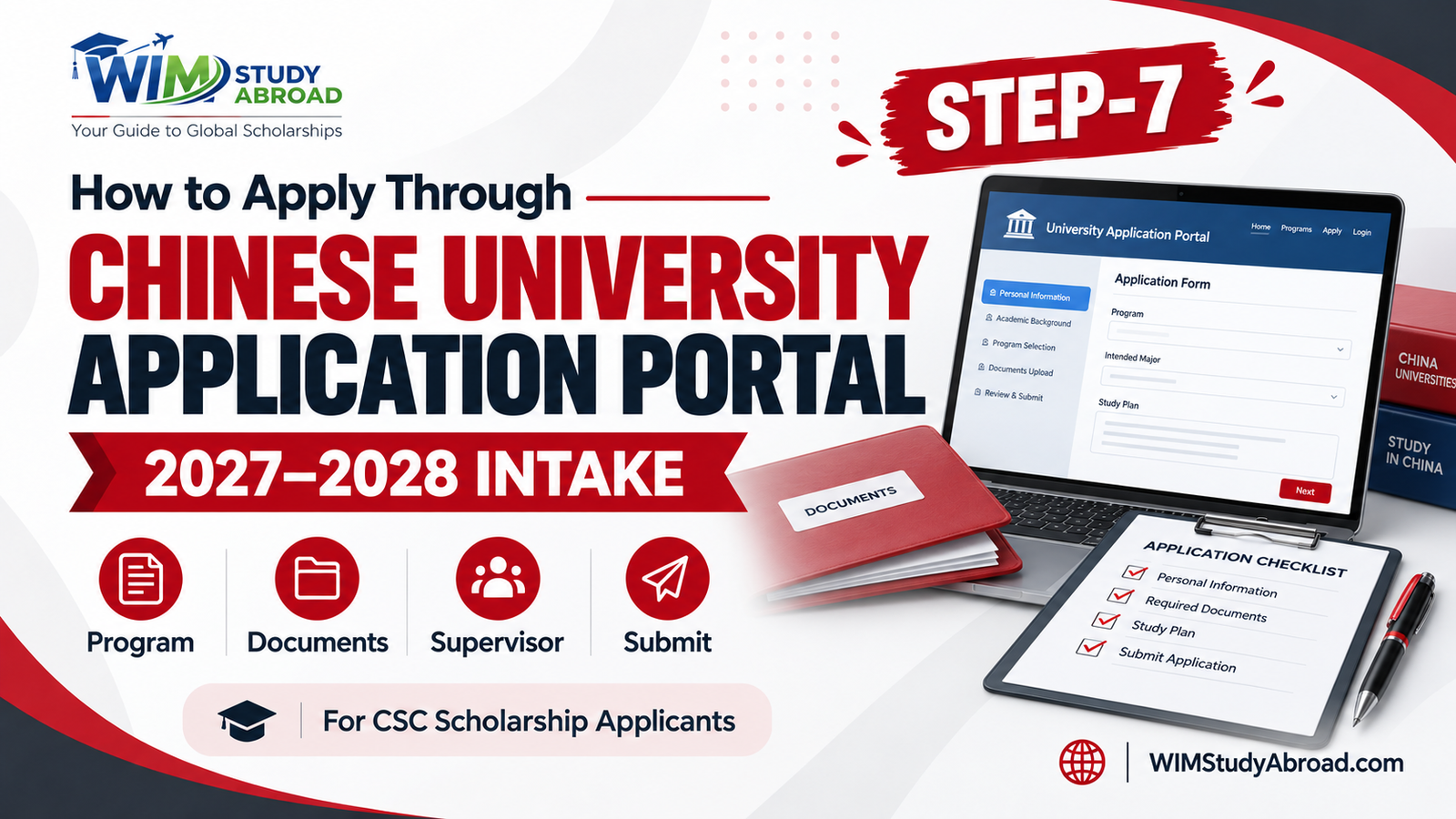
After completing the CSC online application form, many applicants also need to submit a separate application through the official international student application portal of their selected Chinese university.
This is an important step because the CSC portal and university portal are not always the same thing.
For the 2027–2028 intake, applicants should carefully check the latest scholarship announcement of their selected university to confirm whether a separate university application is required.
CSC Portal vs University Portal
| CSC Portal | University Portal |
|---|---|
| Used for Chinese Government Scholarship application | Used for university admission and internal scholarship review |
| Requires Program Category and Agency Number | Requires university program and admission information |
| Operated through CSC | Operated by the individual university |
| Used for CSC scholarship processing | Used by the university to review applicants |
| May generate the CSC application form | May ask you to upload the CSC application form |
| One system for CSC applicants | Different portal for each university |
Submitting the CSC form does not automatically complete the university application when the university requires both systems.
For example, Chongqing University’s current Type B guide requires applicants to submit both the CSC application and a separate application through the university system. Xiamen University also requires applicants to complete both systems for its current University Program scholarship.
Step 1: Find the Official University Scholarship Notice
Do not search Google only for:
Chinese university application portal
Instead, first open the university’s official international admissions website.
Look for sections such as:
- International Students
- Admissions
- Scholarships
- Chinese Government Scholarship
- CSC Scholarship
- High-Level Postgraduate Program
- Application Guide
The official scholarship notice should tell you:
- Whether the university portal is required
- Application deadline
- Application system link
- Degree programs available
- Application fee
- Required documents
- Supervisor requirements
- Interview procedure
Always follow the latest official notice.
Step 2: Open the Official University Application Portal
Each university may use a different system.
Examples include:
- University-developed admission systems
- 17gz international student systems
- University-specific online service portals
Do not assume that two universities use the same portal.
For example, Chongqing University currently uses its own international student online application system in addition to CSC. HUST uses its own admission system, while Xiamen University has a separate XMU international student application platform.
Step 3: Create an Account
Create an account using an active email address.
Use the same email address that you regularly check for:
- Admission notifications
- Interview invitations
- Document requests
- Pre-admission information
- Scholarship results
After registration, verify your email if required.
Save your:
- Login email
- Password
- Application number
You may need them later to check your application status.
Step 4: Select the Correct Application Category
The university portal may ask you to choose an application type.
Possible options may include:
- Chinese Government Scholarship
- CSC Type B
- High-Level Postgraduate Program
- Silk Road Program
- University Scholarship
- Self-Funded Program
Choose the scholarship program stated in the official university notice.
Do not select a general self-funded application if you are applying specifically for a CSC scholarship unless the university instructs you to do so.
Step 5: Select Your Degree and Program
Choose your intended:
- Bachelor’s
- Master’s
- PhD
- Other eligible category
Then select your major.
The selected program should match the program you entered in the CSC system.
For example:
CSC Application:
Master’s in Computer Science
University Portal:
Master’s in Computer Science
Avoid selecting different majors in the two systems unless the university specifically tells you to do so.
Step 6: Complete Personal Information
Enter your information exactly according to your passport.
Common information includes:
- Full name
- Nationality
- Date of birth
- Passport number
- Contact information
- Current address
- Permanent address
Make sure your information is consistent across:
- Passport
- CSC application
- University portal
- Academic documents
Small differences in spelling can create unnecessary problems during document review.
Step 7: Add Educational Background
Enter your previous academic information.
Usually this includes:
- School or university name
- Country
- Major
- Degree
- Start date
- Graduation date
- GPA or academic result
For Master’s applicants, include your Bachelor’s information.
For PhD applicants, include your Bachelor’s and Master’s education if the system requests both.
Do not enter estimated grades if official grades are available.
Step 8: Add Supervisor Information if Required
Some universities ask Master’s or PhD applicants to provide:
- Prospective supervisor name
- Department
- Email address
- Acceptance letter
- Pre-admission letter
Other universities may treat supervisor acceptance as optional.
This requirement varies significantly.
For example, Xiamen University’s current postgraduate CSC University Program requires a pre-acceptance letter signed by the supervisor and stamped by the college, while HUST lists a prospective supervisor acceptance letter as optional for many graduate programs but required by some schools.
Therefore, do not assume that one rule applies to every Chinese university.
Step 9: Enter CSC Application Information
Some university portals ask for your CSC details.
This may include:
- CSC application number
- Program Category
- Agency Number
- CSC application form
If the university asks for the CSC form, download it from the CSC system after submission and upload the correct version.
Make sure the university name and Agency Number in the CSC application match the university where you are applying.
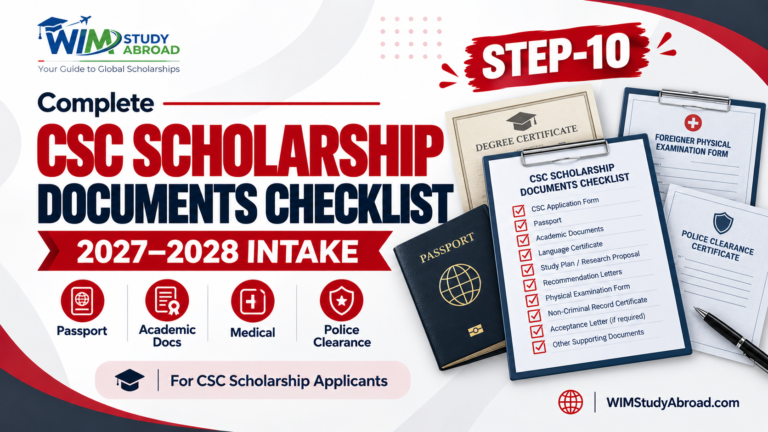
Step 10: Upload Required Documents
The university portal may ask for documents such as:
- Passport
- Highest diploma
- Academic transcripts
- CV
- Study Plan or Research Proposal
- Recommendation letters
- Language certificate
- Foreigner Physical Examination Form
- Non-criminal record certificate
- Acceptance or pre-admission letter
- CSC application form
- Other supporting documents
The exact list varies by university.
Upload clear and complete scans.
Official university guides commonly warn applicants that unclear, incomplete or invalid documents may prevent the application from being reviewed.
Step 11: Check Whether an Application Fee Is Required
Not every university uses the same fee policy.
Some universities charge an application fee, while others may not.
For example, Chongqing University’s current High-Level Postgraduate Type B program requires a 400 RMB non-refundable application fee through its university portal. Some other programs and universities use different fee amounts.
Therefore:
Never assume that CSC scholarship applications are automatically free at the university application stage.
Check the official university announcement.
Step 12: Submit the University Application
After confirming all information, submit the application.
Save:
- University application number
- Screenshot or PDF of submission confirmation
- Payment receipt if applicable
- CSC application form
- Login information
Keep these until the complete admission process is finished.
What Happens After Submission?
The university normally reviews your:
- Eligibility
- Academic background
- Research potential
- Documents
- Language qualifications
- Proposed research
- Supervisor compatibility
Shortlisted applicants may be invited for:
- Interview
- Academic assessment
- Written examination
- Department review
For many CSC Type B programs, the university first reviews applicants and then recommends selected candidates to CSC for final review.
For example, Chongqing University currently conducts university review and may interview applicants before recommending candidates to CSC.
How to Check Application Status
Log in to the university application system regularly.
Common status messages may include:
- Submitted
- Under Review
- Documents Incomplete
- Academic Review
- Interview
- Pre-admitted
- Recommended to CSC
- Admitted
The exact wording differs between universities.
Also check your email regularly.
Universities may send interview notices or document requests by email rather than only through the application portal.
Important: Application Order Can Differ
Do not assume that the application order is always:
CSC first → University second
Different universities may use different workflows.
For example:
Xiamen University:
Current guide requires applicants to complete CSC first and then submit another application through the XMU portal, including the CSC application form.
Chongqing University:
Current Type B guide requires applications through both CSC and the CQU online system.
HUST:
For some current graduate scholarship routes, applicants complete the university admission process and then complete CSC requirements according to the scholarship procedure.
This is why the official university scholarship notice must always be checked first.
Common Mistakes to Avoid
Avoid:
- Applying only on CSC when the university requires both portals
- Using an unofficial application website
- Selecting the wrong scholarship category
- Choosing a program not covered by the scholarship
- Entering a different major from your CSC application
- Uploading the wrong CSC application form
- Forgetting the university application fee
- Missing supervisor requirements
- Uploading blurry documents
- Forgetting to click final Submit
- Ignoring university emails
- Assuming every university follows the same procedure
Official Information
For CSC scholarship applications, applicants should always use:
China Scholarship Council / Campus China
and the:
Official International Student Admissions Website of the Selected University
For the 2027–2028 intake, final application deadlines, portal links, program lists and document requirements should be confirmed from the official university announcement once published.
Final Advice
The most important thing to understand is:
CSC Application and University Application may be two separate applications.
For many Type B scholarship programs, you must complete both.
The safest process is:
Read University Scholarship Notice → Complete CSC Requirements → Complete University Portal → Upload Required Documents → Pay Fee if Required → Submit → Check Email and Application Status
Do not copy the application procedure of another university because each Chinese university can have different requirements.
Important Note
This guide is prepared for students planning to apply for the CSC Scholarship 2027–2028.
Application portals, deadlines, fees, available programs and university procedures may change for the new intake. Always follow the latest official university and CSC instructions.
Check out Latest Posts