
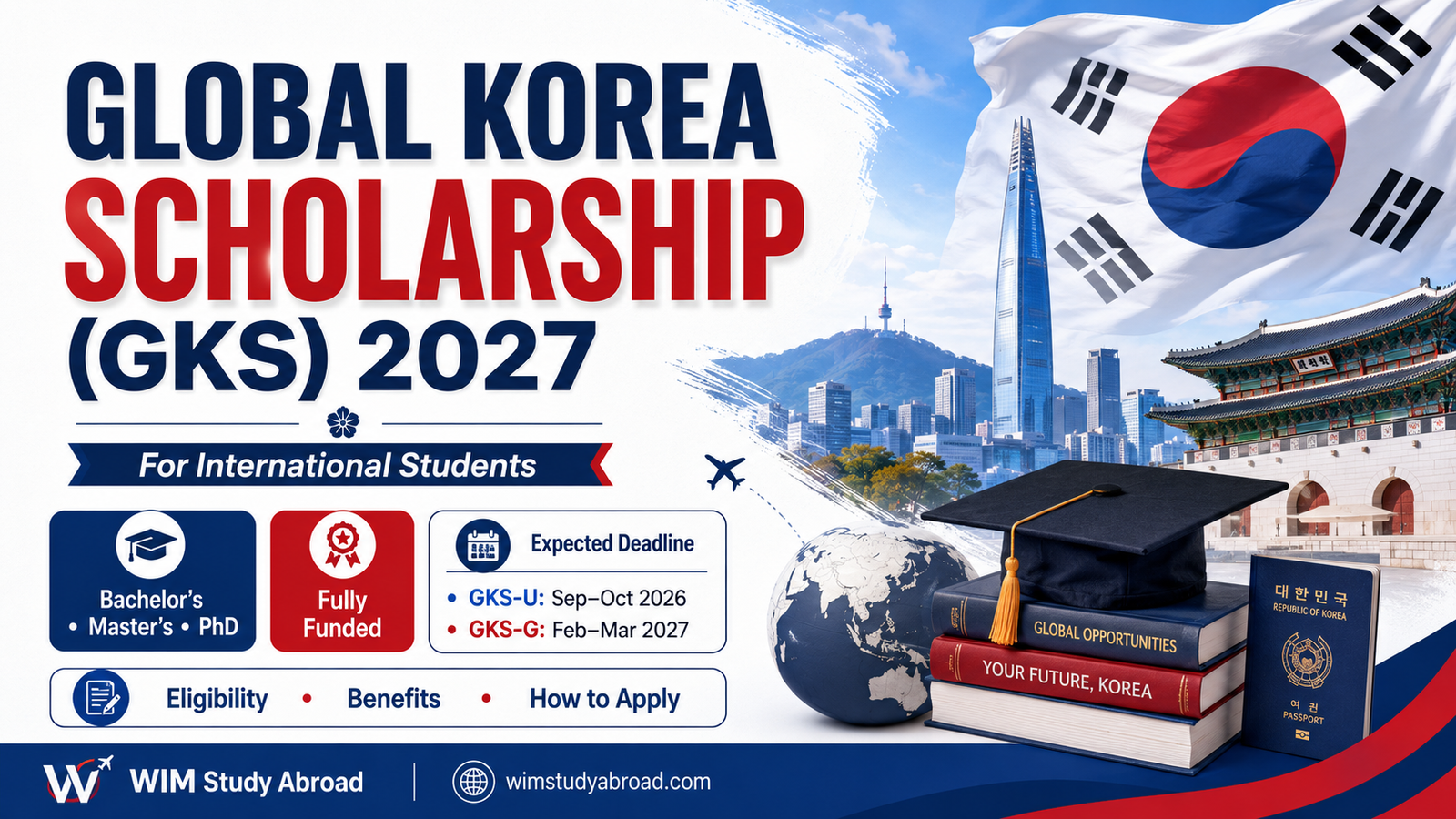
The Global Korea Scholarship (GKS) is one of South Korea’s major government-funded scholarship programs for international students.
The scholarship is administered by the National Institute for International Education (NIIED) and provides opportunities for international students to study at participating Korean universities.
Students can apply for undergraduate, Master’s and PhD programs through different GKS application routes.
This guide explains the main details students should know when preparing for the GKS 2027 intake.
GKS Scholarship 2027 at a Glance
| Item | Details |
|---|---|
| Scholarship | Global Korea Scholarship (GKS) |
| Country | South Korea |
| Funded By | Government of the Republic of Korea / NIIED |
| Degree Levels | Associate, Bachelor’s, Master’s and PhD |
| Main Routes | Embassy Track and University Track |
| Undergraduate Applications | Expected around September–October 2026 |
| Graduate Applications | Expected around February–March 2027 |
| Funding | Tuition, airfare, language training and study allowance |
| Academic Requirement | Generally 80% or above |
| Application Platform | Study in Korea |
The exact 2027 deadlines, quotas, participating universities and scholarship benefits should be confirmed when the official GKS 2027 guidelines are released.
What Is the Global Korea Scholarship?
The Global Korea Scholarship is designed to support international students who want to pursue higher education in South Korea.
It provides financial support while allowing students to study at participating Korean universities in a wide range of academic fields.
There are two main degree scholarship categories:
GKS-U
GKS-U is the undergraduate scholarship program.
It may include:
- Bachelor’s degree programs
- Selected associate degree programs
GKS-G
GKS-G is the graduate scholarship program.
It mainly includes:
- Master’s degree programs
- PhD degree programs
- Selected research or specialized programs
GKS Scholarship Benefits
GKS is considered a comprehensive scholarship because it may provide support for several major study expenses.
Benefits generally include:
- Tuition fee support
- Round-trip airfare
- Korean language training
- Monthly study or living allowance
- Other scholarship support according to the official guidelines
Some students may complete Korean language training before beginning their degree program.
The exact financial amounts and benefits for 2027 should be checked in the official GKS 2027 guidelines.
GKS Undergraduate Eligibility
Students applying for GKS-U generally need to meet requirements related to nationality, age, education and academic performance.
Nationality
The applicant and both parents are generally required to hold non-Korean citizenship.
Applicants should carefully check the nationality conditions in the official guidelines, especially in cases involving dual nationality or previous Korean citizenship.
Age Requirement
Undergraduate applicants are generally required to be under 25 years of age in the relevant selection year.
The official 2027 guidelines will provide the exact date used for determining eligibility.
Educational Requirement
Applicants for a Bachelor’s degree generally need to have completed, or be expected to complete, high school before starting their studies in Korea.
Applicants for eligible associate degree programs should follow the specific educational requirements provided for those programs.
Academic Requirement
Applicants generally need an academic performance equivalent to at least 80% in their most recent educational program.
The official guidelines may also provide accepted GPA scales and conversion methods.
GKS Graduate Eligibility
Students applying for Master’s or PhD programs have separate academic requirements.
Nationality
The applicant and both parents are generally required to hold non-Korean citizenship.
Age Requirement
Graduate applicants are generally required to be under 40 years of age.
Applicants should confirm the exact age calculation date from the GKS 2027 graduate guidelines.
Master’s Applicants
Students applying for a Master’s program should normally have completed, or be expected to complete, a Bachelor’s degree.
PhD Applicants
Students applying for a PhD program should normally have completed, or be expected to complete, a Master’s degree.
Academic Performance
Graduate applicants generally need academic performance equivalent to at least 80% in their previous degree.
Additional requirements may apply depending on the university and program.
Embassy Track vs University Track
GKS applications are mainly submitted through two routes.
Embassy Track
Under the Embassy Track, applicants apply through the Korean Embassy responsible for their country.
The embassy conducts the initial screening and forwards successful candidates for the next stages of selection.
Depending on the annual guidelines, Embassy Track applicants may be allowed to select more than one participating university.
The number of available positions and university-selection rules can differ by country and application cycle.
University Track
Under the University Track, applicants apply through a participating Korean university.
The university reviews applications and recommends selected candidates to NIIED for further evaluation.
University Track can be suitable for students who have already identified a specific university and academic program.
Which Track Should You Choose?
There is no single best route for every student.
Consider:
- Your country’s available quota
- Your preferred university
- Available academic programs
- Your degree level
- Embassy Track restrictions
- University Track availability
- Your academic profile
Always follow the application restrictions given in the official GKS guidelines.
GKS 2027 Application Timeline
GKS Undergraduate and Graduate programs normally follow different schedules.
Expected GKS-U 2027 Timeline
The undergraduate scholarship process usually begins during the second half of the previous year.
Students preparing for GKS-U 2027 should expect the main process around:
- Official announcement: Around September 2026
- Applications: Around September–October 2026
- Selection process: Around October–December 2026
- Final results: Usually toward the end of the selection cycle
The exact deadline can differ between Korean embassies and participating universities.
Therefore, students should not rely on one general deadline.
Expected GKS-G 2027 Timeline
Graduate applications normally open later.
Students preparing for GKS-G 2027 should expect approximately:
- Official announcement: Around February 2027
- Applications: Around February–March 2027
- Screening and evaluation: Around April–June 2027
- Final results: Around June 2027
The final dates will be available when NIIED publishes the official 2027 GKS-G guidelines.
Important Deadline Advice
Do not wait for the final application week before preparing your documents.
Embassies and universities can have different submission deadlines.
Once the official notice is released, check:
- Study in Korea announcement
- Korean Embassy website in your country
- Participating university website
The deadline published by your specific receiving institution is the one you should follow.
Documents Required for GKS
The final 2027 document checklist has not yet been released.
However, GKS applications generally require documents such as:
- GKS application form
- Personal statement
- Study plan
- Recommendation letter
- Applicant agreement
- Personal medical assessment
- Proof of citizenship
- Proof of parents’ citizenship
- Family relationship documents
- Graduation or expected graduation certificate
- Academic transcripts
Depending on your situation, additional supporting documents may include:
- TOPIK certificate
- English language certificate
- Academic awards
- Publications
- Professional certificates
- Other relevant achievements
Always prepare documents according to the official GKS 2027 checklist.
Personal Statement
The personal statement is an important part of the GKS application.
It should clearly explain:
- Your academic background
- Your motivation
- Important experiences
- Achievements
- Skills
- Academic or professional interests
- Why you want to study in Korea
Avoid copying another student’s personal statement.
Your statement should represent your own background and goals.
Study Plan
Your study plan should explain what you intend to achieve during your studies in South Korea.
You may discuss:
- Intended academic field
- Study goals
- Research interests
- Language preparation
- Academic development
- Future career plans
Keep the plan realistic and related to your chosen degree.
Is TOPIK Required?
Applicants should not automatically assume that TOPIK is mandatory for every GKS application.
Requirements can vary depending on the degree program, university and scholarship guidelines.
Applicants with Korean language ability may have advantages in certain situations.
Many GKS scholars also receive Korean language training before beginning their degree program.
If you have an official TOPIK certificate, include it according to the application instructions.
What About IELTS or TOEFL?
English language requirements depend on the university and program.
Some universities may accept IELTS, TOEFL or other recognized English proficiency documents.
Other programs may have different language requirements.
Always check:
- GKS guidelines
- University admission requirements
- Department requirements
Do not assume the same language requirement applies to every university.
How Many GKS Scholarships Are Available?
The number of available scholarships changes each year.
The total quota may be divided according to:
- Undergraduate and graduate programs
- Embassy Track
- University Track
- Countries or regions
- Participating universities
- Special academic programs
Students should wait for the official 2027 guidelines before treating any quota as confirmed.
How to Apply for GKS 2027
The general application process is:
- Decide whether you are applying for GKS-U or GKS-G.
- Read the official 2027 guidelines carefully.
- Check whether your country is eligible.
- Review the available quota.
- Choose Embassy Track or University Track.
- Check participating universities and departments.
- Prepare all required documents.
- Complete your personal statement and study plan.
- Submit your application through the correct route.
- Attend an interview if requested.
- Follow the official selection results.
Never submit an application without checking the requirements for your specific route.
How to Choose a Korean University
Do not select a university only because it is famous.
Check whether:
- Your intended major is available
- The university participates in your GKS route
- Your academic profile matches the program
- The program is taught in Korean or English
- Language requirements are suitable
- The university offers your degree level
- Your research interests match the department
Graduate applicants should also consider research areas and potential supervisors where relevant.
How to Prepare for GKS-U 2027 Now
Students targeting undergraduate admission should start preparing immediately because the expected application period is approaching.
Prepare:
- Passport and citizenship documents
- Academic transcripts
- Graduation documents
- Recommendation arrangements
- Personal statement draft
- Study plan draft
- Language certificates
- Awards and supporting documents
Also start researching suitable Korean universities and programs.
How to Prepare for GKS-G 2027
Graduate applicants have additional time, but early preparation is still recommended.
Start by:
- Selecting your intended research field
- Comparing Korean universities
- Checking Master’s or PhD programs
- Preparing your academic CV
- Organizing degree documents and transcripts
- Preparing your research or study interests
- Reviewing previous GKS guidelines
- Preparing recommendation letters
This will make the final application process much easier when the official 2027 guidelines are released.
Common GKS Application Mistakes
Avoid:
- Using outdated guidelines
- Missing embassy or university deadlines
- Choosing an ineligible university
- Ignoring academic requirements
- Submitting incomplete documents
- Copying a personal statement
- Providing incorrect information
- Applying through prohibited multiple routes
- Waiting until the last week to prepare documents
- Selecting universities without checking the available program
Carefully reviewing the official guidelines can prevent many application mistakes.
Is GKS Fully Funded?
GKS provides extensive financial support, including major study-related expenses such as tuition, airfare and living support.
However, applicants should always review the official scholarship benefits for their specific intake.
Do not assume that every expense will automatically be covered without checking the conditions.
Final Advice for GKS 2027 Applicants
Global Korea Scholarship can be an excellent opportunity for students who want to study in South Korea.
The most important preparation steps are:
- Check your eligibility
- Maintain accurate academic documents
- Research universities carefully
- Prepare a strong personal statement
- Write a clear study plan
- Choose the correct application track
- Follow the official deadline
For students targeting undergraduate programs, the GKS-U 2027 announcement is expected around September 2026.
Graduate applicants should prepare for the GKS-G 2027 application cycle expected around February 2027.
Exact deadlines, quotas, participating universities and financial benefits should only be considered confirmed once the official GKS 2027 guidelines are published.
Always verify final information through the official Study in Korea website, the Korean Embassy responsible for your country, or the participating Korean university.
Important Note
This guide is intended to help international students prepare for the Global Korea Scholarship 2027.
Scholarship requirements, deadlines, university lists, quotas and benefits can change between admission cycles. Applicants should always follow the official GKS 2027 guidelines when they become available.
Great post. I used to be checking constantly
this blog and I’m inspired! Extremely useful info specially the ultimate part 🙂 I care
for such info much. I used to be looking for this particular information for a long time.
Thanks and best of luck.