
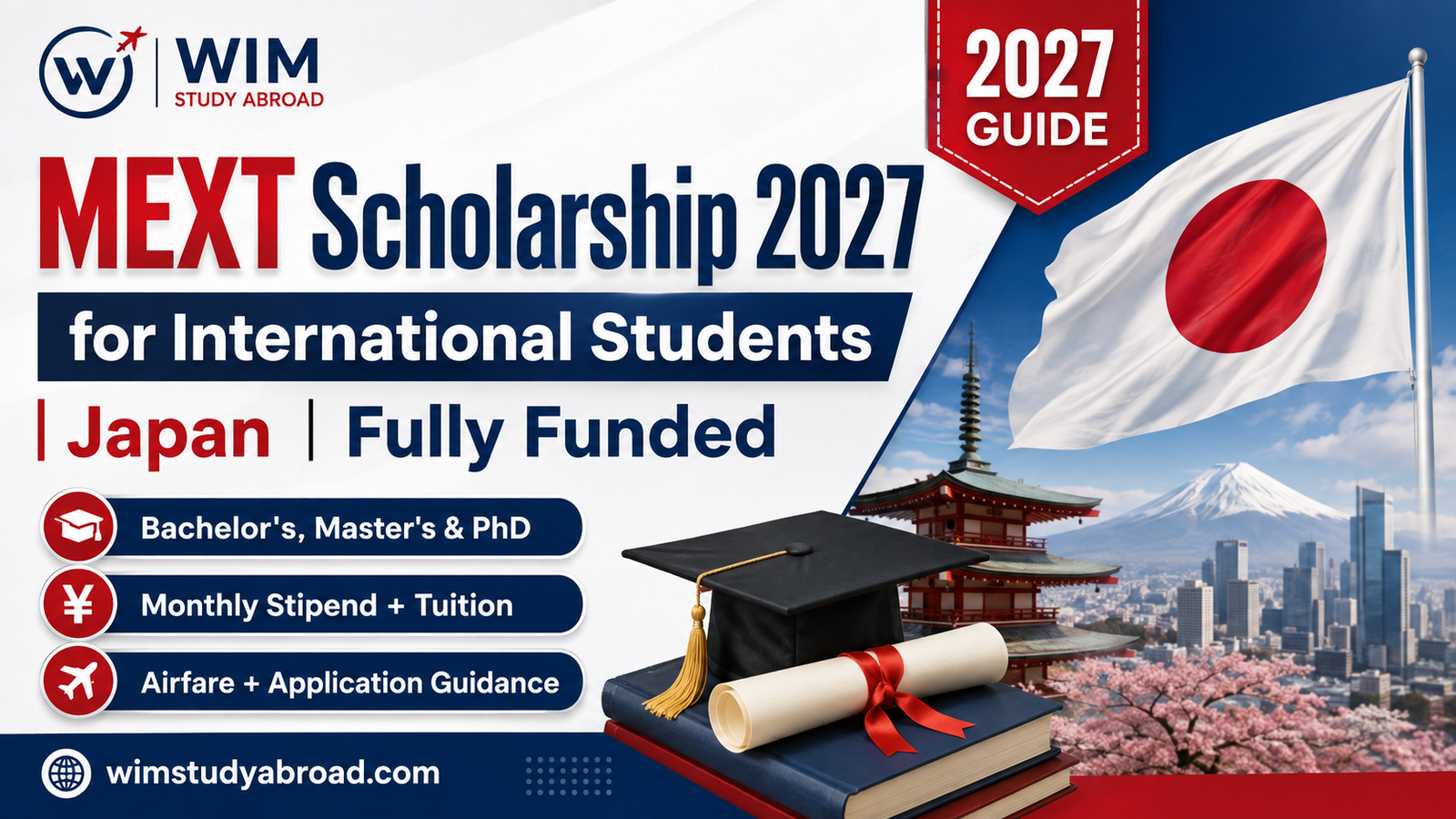
The Japanese Government MEXT Scholarship is one of the major scholarship opportunities for international students who want to study in Japan.
MEXT stands for the Ministry of Education, Culture, Sports, Science and Technology of Japan. The scholarship supports several categories of international students, including undergraduate, Master’s, PhD and research applicants.
For the 2027 intake, official Embassy Recommendation guidelines have already been released for major categories such as Undergraduate and Research Students.
This guide explains the scholarship types, eligibility, benefits, application routes, 2027 timeline and selection process.
MEXT Scholarship 2027 at a Glance
| Item | Details |
|---|---|
| Scholarship | Japanese Government (MEXT) Scholarship |
| Country | Japan |
| Funded By | Government of Japan / MEXT |
| Main Degree Levels | Bachelor’s, Master’s, PhD and Research |
| Main Application Routes | Embassy Recommendation and University Recommendation |
| Tuition | Exempted under scholarship conditions |
| Monthly Allowance | Depends on scholarship category |
| Airfare | Eligible round-trip airfare provided under MEXT rules |
| Undergraduate 2027 Allowance | ¥117,000 per month |
| Research/Master’s/PhD Allowance | ¥143,000–¥145,000 per month |
| 2027 Embassy Applications | Mainly opened during April–May 2026; exact deadlines varied by country |
MEXT officially offers seven scholarship categories, and application routes and eligibility differ by category.
What Is the MEXT Scholarship?
The MEXT Scholarship is funded by the Japanese Government to support international students studying at Japanese educational institutions.
The official program includes seven categories:
- Research Students
- Undergraduate Students
- Teacher Training Students
- Japanese Studies Students
- College of Technology Students
- Specialized Training College Students
- Young Leaders Program (YLP)
For most international students seeking full degree opportunities, the two most relevant categories are:
Undergraduate Students — mainly for Bachelor’s-level study.
Research Students — mainly for graduate-level study, including Master’s, PhD and non-degree research pathways.
MEXT Scholarship Benefits
One of the major advantages of MEXT is that it provides comprehensive financial support.
Monthly Allowance
For 2027 Undergraduate Scholarship recipients:
¥117,000 per month
Students studying in certain designated regions may receive an additional regional allowance of ¥2,000 or ¥3,000 per month.
For 2027 Research Students:
- Preparatory/non-regular research students: ¥143,000 per month
- Master’s or professional degree students: ¥144,000 per month
- Doctoral students: ¥145,000 per month
A regional supplement may also apply in designated areas.
Tuition Fees
For scholarship recipients, MEXT generally waives:
- Entrance examination fees
- Matriculation/admission fees
- University tuition fees
The detailed conditions depend on the scholarship route and academic progression.
Airfare
MEXT generally provides eligible scholarship recipients with an economy-class airline ticket to Japan according to the official travel rules.
Return airfare may also be provided after completing the scholarship and returning home within the specified conditions.
MEXT Undergraduate Scholarship 2027
The Undergraduate Scholarship is intended for students planning to complete a Bachelor’s degree in Japan.
Applicants can select fields within:
Social Sciences and Humanities
Examples include:
- Law
- Politics
- Economics
- Business Administration
- Sociology
- Literature
- History
- Education
Natural Sciences
Examples include:
- Mathematics
- Physics
- Chemistry
- Computer and Information Engineering
- Electrical Engineering
- Mechanical Engineering
- Civil Engineering
- Architecture
- Agriculture
- Biology
- Pharmacy
- Nursing
- Medicine
- Dentistry
The official 2027 guidelines provide detailed eligible majors and field combinations.
MEXT Undergraduate Eligibility 2027
Nationality
Applicants must generally hold the nationality of a country that has diplomatic relations with Japan.
Japanese nationals are generally not eligible, although specific provisions apply to certain dual nationals who meet MEXT requirements.
Age
For the 2027 Undergraduate Scholarship, applicants must generally have been born:
On or after April 2, 2002.
Education
Applicants generally need to have completed 12 years of schooling or meet an equivalent qualification accepted for admission to a Japanese university.
Students expected to complete the required education before enrollment may also be eligible under the conditions in the guidelines.
Will Undergraduate Students Study in Japanese?
In principle, MEXT undergraduate applicants should be willing to learn Japanese and undertake their academic studies in Japanese.
Most scholars complete approximately one year of preparatory education, including Japanese language and other relevant subjects, before entering university.
However, some applicants may qualify for direct placement into a university where the program and language requirements allow it.
MEXT Scholarship Duration for Undergraduate Students
For most undergraduate scholars completing preparatory education, the scholarship normally lasts:
5 years, including one year of preparatory study.
For medicine, dentistry, veterinary medicine and certain six-year pharmacy programs, the scholarship can extend to:
7 years.
Students qualifying for direct university placement normally receive support for the standard degree period.
MEXT Research Scholarship 2027
The Research Student category is particularly important for students planning to pursue graduate education in Japan.
It may include:
- Non-degree research study
- Master’s programs
- Professional graduate programs
- PhD programs
Applicants should generally apply in the same or a related academic field to their previous university education.
MEXT Research Scholarship Eligibility
Age
For the 2027 Research Student Scholarship, applicants generally must have been born:
On or after April 2, 1992.
Academic Background
For Master’s-level admission, applicants generally need academic qualifications that make them eligible to enter a Japanese graduate school.
For example, this may include completion of approximately 16 years of education or an eligible Bachelor’s-equivalent degree.
For doctoral study, applicants normally need the academic background required for admission to the relevant doctoral program, such as an appropriate Master’s-equivalent qualification.
Do You Need Japanese Language Proficiency?
You do not necessarily need advanced Japanese before applying for every MEXT research program.
Research applicants must be willing to learn Japanese and should have sufficient language ability to conduct their intended research and communicate appropriately.
During Embassy Recommendation screening, research applicants are normally tested in:
- Japanese
- English
The required working language ultimately depends on the university, supervisor and academic program.
Embassy Recommendation vs University Recommendation
There are two major ways to apply for MEXT.
1. Embassy Recommendation
Under Embassy Recommendation, applicants apply through the Japanese Embassy or Consulate General responsible for their country.
The diplomatic mission conducts the first screening, which may involve:
- Application document review
- Written examinations
- Interview
Applicants who successfully pass the first stage are recommended for further MEXT screening.
2. University Recommendation
Under University Recommendation, selected Japanese universities recruit and screen candidates before recommending successful applicants to MEXT.
Not every Japanese university has a MEXT recommendation quota.
Application periods, eligibility and available programs therefore depend on the specific university.
Which Route Should You Choose?
Neither route is automatically better.
Embassy Recommendation may be suitable if the scholarship category is available through the Japanese diplomatic mission in your country.
University Recommendation may be suitable when you have identified an eligible Japanese university offering a MEXT recommendation opportunity.
Always check the rules of the specific program before applying.
MEXT Scholarship 2027 Deadline
There is no single worldwide MEXT deadline.
This is important.
Embassy Recommendation 2027
For students arriving in Japan in 2027, Embassy Recommendation recruitment generally took place around:
April–May 2026
The first screening was generally conducted between approximately May and July/August, depending on the category and country.
Every Japanese Embassy or Consulate sets its own detailed submission schedule.
Therefore, many 2027 Embassy Recommendation application deadlines have already passed.
Students should check the Japanese Embassy responsible for their country instead of relying on a general online deadline.
Research Student 2027 Timeline
For Research Students under Embassy Recommendation, the official process includes approximately:
- Application opening: around mid-April 2026
- First screening: May–July 2026
- Requesting provisional acceptance from Japanese universities: by September 1, 2026
- Placement Preference submission: around September–October 2026
- MEXT second screening: from November 2026
- Final selection and university placement: January–March 2027
Applicants who pass the first screening may obtain up to two provisional acceptance letters, while listing up to three universities on the Placement Preference Application Form.
University Recommendation Deadline
There is no universal University Recommendation deadline.
Participating universities publish their own MEXT announcements and application schedules.
Students interested in this route should monitor the official international admissions and scholarship pages of their target universities.
Selection Process
Undergraduate Applicants
The first screening may include document review, interview and written academic examinations.
Depending on the selected field, examinations can include:
- Japanese
- English
- Mathematics
- Chemistry
- Physics
- Biology
The exact examination combination depends on the applicant’s selected field of study.
Research Applicants
The first screening considers:
- Academic documents
- Field of Study and Research Plan
- Japanese and English examinations
- Interview
Applicants should be able to explain clearly why they want to conduct their proposed study in Japan and how their previous academic background connects with their research plan.
Basic Documents Required
The exact document requirements differ between Undergraduate and Research applications.
Common documents may include:
- MEXT application form
- Academic transcripts
- Graduation or expected graduation certificate
- Recommendation letter
- Medical/health certificate
- Language proficiency evidence, if applicable
Research Student applicants also normally submit a:
Field of Study and Research Plan
and may need thesis abstracts and other supporting academic materials where applicable.
We will cover the complete MEXT 2027 document checklist, document format and preparation process in a separate WIM Study Abroad guide.
Do You Need an Acceptance Letter Before Applying?
This depends on the route.
For Research Students applying through Embassy Recommendation, applicants first complete the Embassy’s First Screening.
Applicants who pass that screening then contact Japanese universities to request provisional acceptance.
For the 2027 Embassy Recommendation cycle, applicants were instructed to contact universities by September 1, 2026.
Therefore, students should not randomly contact universities requesting a MEXT provisional acceptance letter before understanding their specific application route.
Common MEXT Application Mistakes
Avoid:
- Using old application forms
- Missing your local Embassy deadline
- Applying under an incorrect scholarship category
- Ignoring age requirements
- Choosing an unrelated research field
- Preparing a generic research plan
- Providing incomplete academic documents
- Assuming IELTS or Japanese requirements are identical for every university
- Contacting universities incorrectly for provisional acceptance
- Relying only on unofficial scholarship websites
Always compare your application with the official guidelines for your intake.
Is the MEXT Scholarship Fully Funded?
MEXT provides extensive financial support and is commonly described as a fully funded scholarship.
For eligible recipients, support generally includes:
- Monthly allowance
- Tuition-related fee exemption
- Eligible airfare
- Preparatory Japanese language education where applicable
However, applicants should understand that some expenses, such as certain domestic travel costs, airport charges, insurance and personal expenses, may remain the student’s responsibility under the official rules.
Final Advice for MEXT 2027 Applicants
The MEXT Scholarship offers opportunities at different academic levels, but applicants should first identify the correct scholarship category and application route.
If you are targeting a Bachelor’s degree, carefully review the Undergraduate Student Scholarship requirements.
If you are planning for Master’s, PhD or research study, review the Research Student Scholarship and prepare a strong research plan.
For the 2027 Embassy Recommendation cycle, many application deadlines occurred during 2026. Students who missed this route should check whether suitable University Recommendation or other Japanese scholarship opportunities are available instead of assuming that all scholarship options for Japan are closed.
Most importantly, use the latest official MEXT, Study in Japan, Japanese Embassy and university information before submitting any application.
Important Note
This guide summarizes major aspects of the MEXT Scholarship 2027 based on official 2027 guidance available at the time of publication.
Application deadlines and available scholarship categories can differ by country and university. The official application guidelines and instructions issued by the relevant Japanese Embassy or university should always take priority.