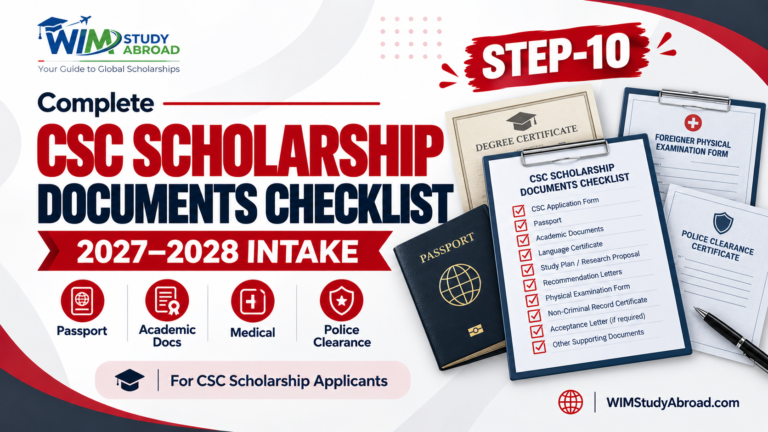
Recommendation letters are an important part of many Chinese Government Scholarship (CSC) applications, particularly for Master’s and PhD applicants.
A recommendation letter gives the university an academic evaluation of your abilities, research potential, character and suitability for further study.
For the CSC Scholarship 2027–2028, applicants should prepare recommendation letters carefully and always check the latest requirements of their selected university.
How Many Recommendation Letters Are Required?
Requirements depend on the study level and university.
| Applicant Level | Common Requirement |
|---|---|
| Bachelor’s | May require one teacher/recommender letter depending on the university |
| Master’s | Usually two recommendation letters |
| PhD | Usually two recommendation letters |
| Senior Scholar | Usually two recommendation letters |
For postgraduate CSC applications, recent official university notices commonly require two recommendation letters in Chinese or English from professors or associate professors.
Individual universities may set additional requirements, so always check the latest admission notice.
Who Should Write Your Recommendation Letter?
For Master’s and PhD applicants, the safest choice is a:
- Professor
- Associate Professor
Choose someone who actually knows your academic work.
Good recommenders may include:
- Thesis supervisor
- Research supervisor
- Professor who taught you important courses
- Department professor familiar with your academic performance
For Bachelor’s applicants, some universities may accept a recommendation from a school teacher or other academic recommender.
Professor or Associate Professor?
Both are commonly accepted for graduate CSC applications.
You do not necessarily need two full professors.
For example:
Letter 1: Professor
Letter 2: Associate Professor
is normally acceptable when the university states that recommendations may come from professors or associate professors.
What Should the Recommendation Letter Include?
A good recommendation letter should briefly cover:
- Recommender’s relationship with the applicant
- Applicant’s academic performance
- Research or technical ability
- Personal and professional qualities
- Ability to pursue graduate study
- Research potential
- Future development potential
- Recommendation for the intended program
For CSC-related applications, official university notices commonly expect recommenders to evaluate the applicant’s comprehensive abilities, study objectives and future development potential.
Recommended Structure
A simple recommendation letter can follow this structure:
1. Recommender Introduction
The professor briefly introduces:
- Name
- Academic position
- Department/university
- Relationship with the applicant
- How long they have known the applicant
2. Academic Evaluation
Explain the applicant’s:
- Academic performance
- Subject knowledge
- Learning ability
- Research skills
- Projects or thesis work
3. Research and Personal Qualities
The recommender may discuss qualities such as:
- Research capability
- Critical thinking
- Responsibility
- Communication skills
- Independence
- Motivation
4. Recommendation
The final paragraph should clearly state that the professor recommends the applicant for further study or the scholarship program.
Short Example Structure
A recommendation letter does not need unnecessary praise or exaggerated language.
For example:
I have known [Student Name] as a student/researcher in the Department of [Department] at [University]. During this period, I observed strong academic performance and a serious interest in [Research Area].
The professor can then briefly discuss your academic or research abilities and conclude with a clear recommendation.
The final letter should reflect the professor’s genuine evaluation rather than using exactly the same wording for every applicant.
Should the Letter Be on University Letterhead?
If your university can provide official letterhead, it is preferable because it helps identify the recommender and institution.
However, letterhead is not a universal CSC requirement for every university.
If your target Chinese university provides its own recommendation template or specific format, follow that requirement instead.
Does the Recommendation Letter Need a Signature?
A signed recommendation letter is strongly recommended, and some universities specifically require the referee’s signature.
It is also useful to include:
- Professor’s full name
- Academic title
- University/department
- Institutional email
- Contact information
- Signature
- Date
Some universities specifically require the recommender’s contact details in addition to the signature.
Is a University Stamp Required?
A university or departmental stamp can make the document more official, but it is not universally required by every CSC university.
Do not assume a stamp is mandatory unless the university specifically asks for one.
The professor’s genuine signature and verifiable academic information are more important.
Which Language Should Be Used?
CSC-related recommendation letters are commonly accepted in:
- English
- Chinese
If the original recommendation is written in another language, check whether an official or notarized translation is required by the university.
Can You Use the Same Recommendation Letter for Different Universities?
The same core academic recommendation may sometimes be reused if it is written generally.
However, avoid using a letter that specifically says:
I recommend this student to University A
when uploading it to University B.
A general version such as:
I strongly recommend the applicant for graduate study and scholarship consideration.
is easier to use for multiple applications.
If the target university provides its own recommendation form, use that form.
Should Both Letters Be Different?
Yes.
The two recommenders should ideally provide their own independent evaluation.
For example:
Professor 1: Discusses your coursework, academic ability and performance.
Professor 2: Discusses your research project, thesis, laboratory work or research potential.
Do not submit two identical letters with only the professor’s name changed.
How to Ask a Professor for a Recommendation Letter
Contact the professor politely and provide enough time.
Send:
- Your updated CV
- Intended degree/program
- Research area
- Scholarship name
- Application deadline
- Short summary of your academic achievements
- Draft or supporting information if the professor requests it
Do not simply send:
Sir, please give me recommendation letter urgently.
A professional request makes the process easier for both you and the professor.
Recommendation Letter vs Acceptance Letter
These are different documents.
| Recommendation Letter | Acceptance Letter |
|---|---|
| Usually written by a professor from your previous/current institution | Usually issued or signed by a prospective professor/university in China |
| Evaluates your academic ability | Indicates willingness or potential willingness to accept/supervise you |
| Commonly required for Master’s/PhD CSC applications | Requirement varies by university |
| Usually two letters for graduate applicants | Usually one acceptance/pre-admission document where required |
Do not upload an acceptance letter in place of an academic recommendation letter unless the university specifically instructs you to do so.
Common Mistakes to Avoid
Avoid:
- Using two identical letters
- Asking someone who does not know your academic work
- Using an assistant professor when the university specifically requires professor/associate professor
- Missing the recommender’s signature
- Providing fake letters or signatures
- Using the wrong university name
- Submitting very old letters when the university specifies a recent issue date
- Ignoring a university-provided recommendation template
- Uploading incomplete or unclear scans
Official Information
CSC applicants should check the official Campus China / China Scholarship Council website and, more importantly, the latest scholarship notice published by their selected Chinese university.
University requirements can differ in areas such as:
- Number of recommendation letters
- Academic rank of recommender
- Signature
- Contact information
- Issue date
- University template
- Online submission procedure
For the 2027–2028 intake, always follow the final official university announcement once it is published.
Final Advice
For most Master’s and PhD CSC applicants, prepare two strong academic recommendation letters from professors or associate professors who genuinely know your work.
The letters should provide a clear academic evaluation rather than only saying that you are a good student.
Keep them professional, signed and consistent with the rest of your CSC application.
Important Note
This guide is for students preparing for the CSC Scholarship 2027–2028. Final requirements may differ between Chinese universities and scholarship programs. Official CSC and university instructions should always take priority.
Overlay1