
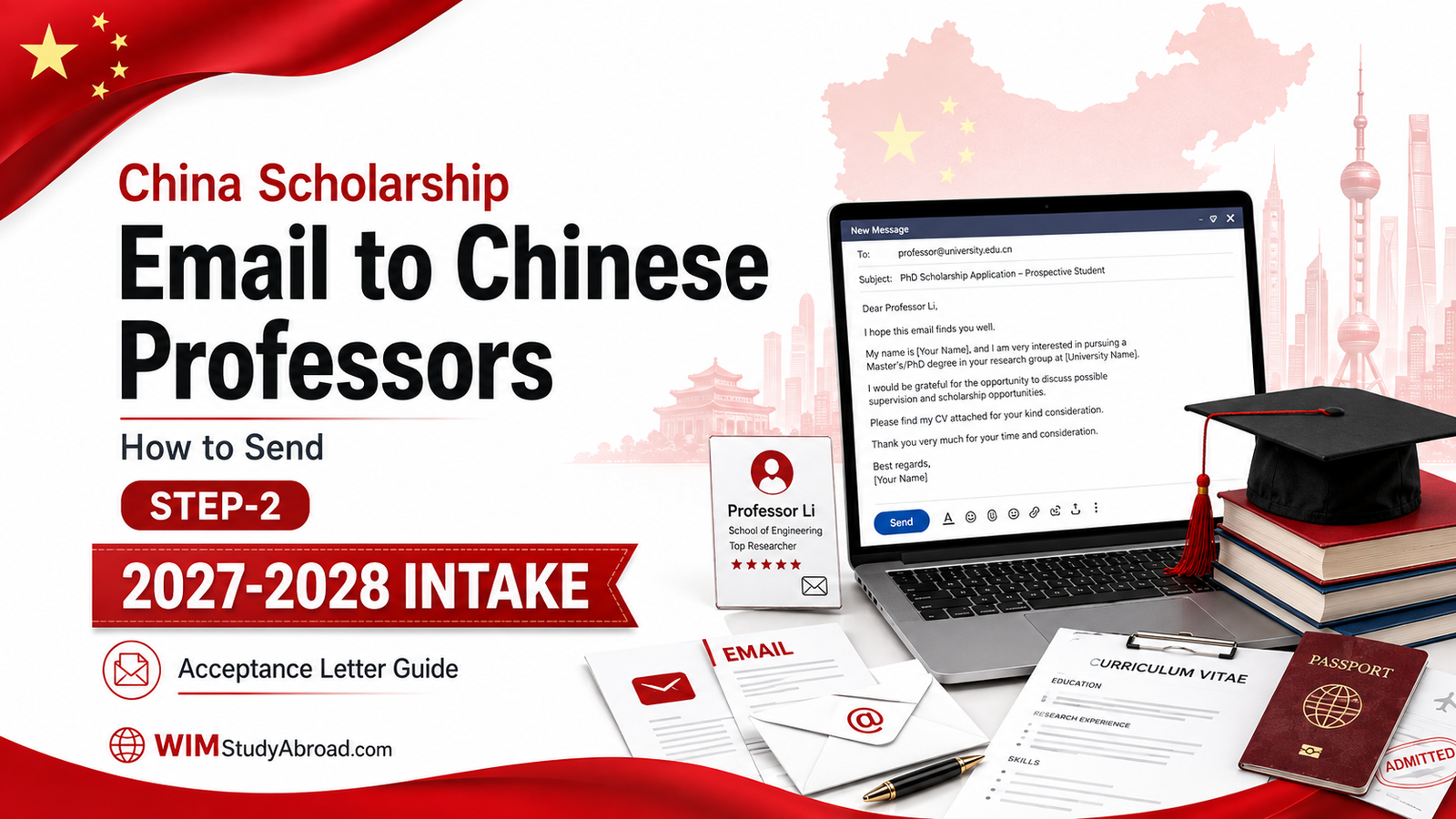
If you are preparing for a China Scholarship or Chinese Government Scholarship (CSC) application for the 2027–2028 intake, contacting a suitable professor can be an important part of your preparation, especially for Master’s and PhD applicants.
A professional email can help you introduce your academic background, explain your research interests and ask whether the professor is accepting new international students.
However, sending the same generic email to hundreds of professors is not a good approach.
In Step 2 of the WIM Study Abroad China Scholarship Guide, we explain how to write a short, professional and personalized email to a Chinese professor.
Before You Email a Professor
Do not start emailing professors before checking whether their work is relevant to your academic background.
Before sending an email, check:
- Professor’s full name
- University and department
- Current research areas
- Recent publications or projects
- Whether the professor supervises Master’s or PhD students
- Whether your intended major matches the professor’s field
- Official university email address
Your goal should be to contact relevant professors, not simply as many professors as possible.
Prepare Your Academic CV First
Before contacting professors, prepare a professional academic CV.
Your CV should clearly present your:
- Education
- Research interests
- Thesis or final-year project
- Research experience
- Publications, if any
- Academic projects
- Technical skills
- Awards and achievements
If you have not prepared your CV yet, complete Step 1 first:
Step 1: How to Prepare a Professional CV for China Scholarship 2027–2028
A free editable Word CV template is also available in our Step 1 guide.
Use Your Own Professional Email Address
Use a simple and professional email address.
For example:
Avoid:
coolboy786@gmail.com
If possible, use your university email address or an email based on your real name.
Also make sure the name displayed on your email account matches your actual name.
How to Write the Email Subject
Professors receive many emails, so the subject should immediately explain why you are contacting them.
Keep it short and specific.
Recommended Subject Lines
You can use:
Prospective Master’s Student – Request for Supervision – 2027 Intake
or
Prospective PhD Student – Research Interest in [Field] – 2027 Intake
or
Request for Master’s/PhD Supervision – CSC Scholarship 2027–2028
Another useful format is:
Prospective PhD Student – [Research Area] – [Your Name]
Avoid subjects such as:
- Hello Professor
- Scholarship Please
- Need Acceptance Letter
- Urgent
- Please Help Me
- CSC Scholarship
A clear academic subject looks much more professional.
How to Start the Email
Use the professor’s correct title and name.
For example:
Dear Professor Zhang,
or
Dear Prof. Zhang,
Avoid starting with:
Dear Sir/Madam
if you already know the professor’s name.
Also check the spelling of the professor’s name before sending the email.
Introduce Yourself Briefly
Your first paragraph should be short.
Mention:
- Your name
- Country
- Current or previous degree
- University
- Field of study
Example:
My name is Muhammad Ali from Pakistan. I recently completed my BS in Computer Science from XYZ University, where my academic work focused mainly on artificial intelligence and computer vision.
There is no need to write your complete life history.
Explain Why You Are Contacting That Professor
This is one of the most important parts of the email.
Show that you have actually checked the professor’s research.
For example:
I reviewed your research profile and was particularly interested in your work on medical image analysis and deep learning. My final-year project also involved deep-learning-based image classification, which is closely related to my intended graduate research direction.
This is much stronger than writing:
Your research interests match my interests.
Try to mention one genuine connection between your background and the professor’s research.
Ask About Supervision
After introducing your research connection, politely ask whether the professor is accepting students.
For example:
I am planning to apply for a Master’s program for the 2027 intake and would like to ask whether you are currently considering international students for supervision in your research group.
For PhD applicants:
I am preparing to apply for a PhD program for the 2027 intake and would be grateful to know whether you are accepting new doctoral students whose research interests align with your group.
This sounds more professional than immediately demanding an acceptance letter.
Mention the Scholarship Briefly
If you are preparing for CSC or another scholarship, mention it briefly.
For example:
I am currently preparing my application for the Chinese Government Scholarship (CSC) and relevant university scholarship opportunities for the 2027–2028 intake.
Do not make the entire email about funding.
Your academic fit should remain the main focus.
Mention Your CV Attachment
At the end of the email, tell the professor that your CV is attached.
For example:
I have attached my academic CV for your reference, which provides further details about my education, research experience and technical skills.
If you have relevant publications, you may also include your:
- Google Scholar profile
- Personal academic website
- ORCID profile
- Selected publication
Do not attach a large number of unnecessary documents in your first email.
Professional Email Template for Master’s Applicants
Subject: Prospective Master’s Student – Request for Supervision – 2027 Intake
Dear Professor [Surname],
My name is [Your Name] from [Country]. I have completed/am currently completing my Bachelor’s degree in [Major] at [University Name].
I reviewed your research profile and was particularly interested in your work on [specific research area]. My academic background includes experience in [your relevant area/project], and I am interested in continuing my graduate studies in a related research direction.
I am preparing to apply for a Master’s program for the 2027 intake and would like to ask whether you are currently considering international students for supervision in your research group.
I am also preparing applications for the Chinese Government Scholarship (CSC) and relevant university scholarship opportunities.
I have attached my academic CV for your reference. I would be grateful if you could review my profile when convenient.
Thank you very much for your time and consideration.
Best regards,
[Your Full Name]
[Current Degree / Department]
[University Name]
[Country]
Email: [Email Address]
Professional Email Template for PhD Applicants
Subject: Prospective PhD Student – Research Interest in [Research Area] – 2027 Intake
Dear Professor [Surname],
My name is [Your Name] from [Country]. I hold a Master’s degree in [Major] from [University Name], where my research focused on [brief research area].
I recently reviewed your research work on [specific topic/project/publication], and I found a strong connection with my previous research in [your relevant research area].
I am preparing to apply for a PhD program for the 2027 intake and am particularly interested in conducting research on [brief intended research direction]. I would therefore like to ask whether you expect to accept new international PhD students in your research group.
I am preparing applications for the Chinese Government Scholarship (CSC) and other available scholarship opportunities.
My academic CV is attached for your reference. If my background is relevant to your current research, I would be grateful for an opportunity to discuss possible supervision.
Thank you for considering my inquiry.
Best regards,
[Your Full Name]
[Current Position / Department]
[University Name]
[Country]
Email: [Email Address]
Should You Directly Ask for an Acceptance Letter?
It is usually better not to make your first sentence a direct request for an acceptance letter.
First introduce yourself and establish whether the professor is interested in supervising you.
If the professor responds positively, you can then politely ask whether they can provide the supervisor acceptance, invitation or pre-admission document required by that university.
This is also important because requirements differ between universities.
For example, Dalian University of Technology’s published scholarship guidance states that a supervisor acceptance letter is not obligatory, while Xiamen University’s 2026 CSC postgraduate instructions require applicants to obtain a supervisor-signed and college-stamped pre-acceptance letter.
Therefore, always check the requirements of the university you intend to apply to.
What Should You Attach?
For the first email, your academic CV in PDF format is usually the most useful attachment.
A professional file name is better than a random one.
Use:
Muhammad_Ali_Academic_CV.pdf
Instead of:
cvfinalnewupdated2.pdf
If necessary and relevant, you may later provide:
- Research proposal
- Academic transcripts
- Publications
- Degree certificates
- Language certificates
Do not send all documents unless the professor or university asks for them.
Keep the Email Short
Professors are busy.
Your first email should normally be easy to read within a short time.
Try to cover only:
- Who you are
- Your academic background
- Why that professor’s research interests you
- What program you intend to apply for
- Whether they are accepting students
- Your attached CV
Avoid writing several long paragraphs.
Personalize Every Email
Do not send exactly the same email to every professor.
You can keep the basic structure, but personalize:
- Professor’s name
- University
- Research area
- Relevant publication/project
- Connection with your own research
The personalized research paragraph is particularly important.
It shows that you are contacting the professor for a genuine academic reason.
Common Email Mistakes to Avoid
Avoid:
- Sending the same mass email to many professors
- Using the wrong professor’s name
- Writing very long emails
- Asking for an acceptance letter in the first sentence
- Claiming research experience you do not have
- Using informal language
- Sending an empty email with only a CV attached
- Using unclear subject lines
- Attaching very large files
- Sending repeated emails every day
- Writing “Dear Sir” when you know the professor’s name
- Saying that you can work on “any research topic”
Your email should show that you have a specific academic direction.
What If the Professor Does Not Reply?
Do not assume that no reply means rejection.
Professors may receive many emails or may simply be busy.
If there is no response, you can send one polite follow-up email after a reasonable period.
Keep the follow-up short.
For example:
Dear Professor [Surname],
I hope you are doing well. I am following up on my previous email regarding potential Master’s/PhD supervision for the 2027 intake.
I understand you may have a busy schedule. I would be grateful if you could kindly let me know whether you are currently considering new international students.
My CV is attached again for convenience.
Thank you for your time.
Best regards,
[Your Name]
If there is still no reply after a follow-up, move on and contact other suitable professors.
Is a Professor’s Acceptance Letter Mandatory for CSC?
Not for every university or every application route.
Requirements can differ significantly by university and scholarship program. Current university guidance demonstrates this variation: some universities treat supervisor acceptance as optional, while others require it for particular postgraduate scholarship programs.
Therefore, do not rely on a general website or social media post.
Check the latest official admission notice of the university where you plan to apply.

Important Advice for 2027–2028 Applicants
The 2027–2028 application cycle is still ahead, and universities may update their scholarship procedures, required documents, programs and supervisor requirements.
Use this guide to prepare early, but verify the official requirements once your target universities publish their 2027–2028 admission notices.
What Comes Next?
After learning how to write a professional email, the next step is to identify the right Chinese universities, departments and professors for your academic profile.
In the next part of the WIM Study Abroad China Scholarship 2027–2028 Step-by-Step Guide, we will explain how to find professors, check their research areas and locate their official university email addresses.
Step 1: Prepare a Professional Academic CV
Step 2: Send a Professional Email to Chinese Professors
Next: Find Suitable Chinese Professors and Official Contact Information